Never miss an emergency restoration call again
RankLadder answers every call with your greeting, captures the type of loss and the address, routes active emergencies to your on-call crew, and puts each call summary in your inbox. Around the clock, on every plan.
See how RankLadder could work for your business. We’ll email you to arrange your demo.

“Water rising fast, whole basement is soaked.”
The dashboard
What does an AI office manager do for restoration companies?
RankLadder is the AI office manager for restoration companies. It answers flooded-basement and fire-loss emergencies, storm-surge overflow, and after-hours leak questions while your crew runs fans on site, transfers active emergencies to whoever is on call, and captures the loss and address on every call.
Speed to answer decides who rolls the truck
Your crew can’t answer from a flooded basement
Storms turn a slow week into a flood of calls
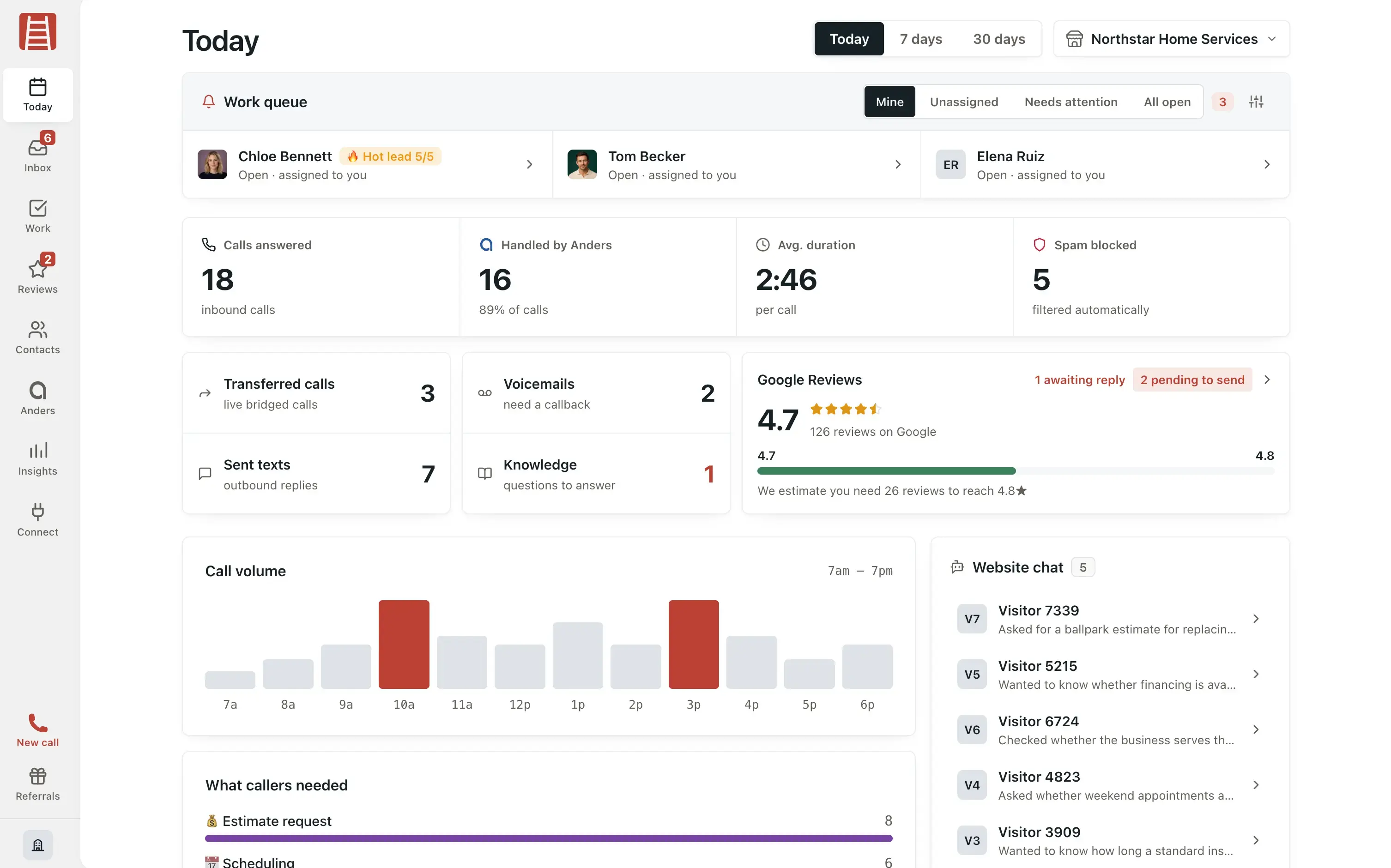
RankLadder interface. Example customer data.
Incoming call
Emergency · flooded basement
Outgoing call
Emergency Calls
Texted
Inspection · mold concern
Chatted
After-Hours Questions
The inbox
Every conversation. One inbox.
Calls, texts, and website questions from your customers stay in one thread. Your team sees what happened and what comes next without asking anyone to start over.
Collect the location and reported flood, fire, or sewage damage, then transfer urgent requests to your chosen on-call number.
Capture each storm-damage address and reported severity so your team can review the incoming work.
A homeowner calling at 11 PM about a leak gets real answers from your knowledge base, not a voicemail beep.
Built around your business
An AI office manager that already knows your business.
Give RankLadder your services, prices, policies, and handoff rules. It answers from what you approve and knows when to bring in a person.
AI Call Answering
RankLadder answers with your greeting while your crew is on site running fans and pulling wet drywall.
Urgent Call Routing
You define what counts as an emergency: an active flood, a fire loss, sewage backing up, mold spreading fast.
After-Hours Coverage
Capture overnight damage reports and transfer urgent calls according to the restoration team’s on-call rules.
On your phone
Leave the job without leaving the call behind.
The summary, customer details, next step, and full conversation follow you onto your phone. See what RankLadder handled and what still needs you.
Available on Android. iPhone app coming soon.
Get RankLadder on Google PlaySee who needs you next
Open the summary, transcript, and customer history before you call back.
Keep the next step in one thread
Reply with the conversation in view, so customers do not need to repeat themselves.
Share the work with your team
Assign a conversation, leave an internal note, and mark it Done when it is handled.
App preview. Example customer data.
A strong start for your business
Keep the number your customers already know.
Get your RankLadder number
Get a dedicated local line for RankLadder. Keep your existing business number for your customers.
Teach RankLadder
Approve your greeting, business answers, transfer rules, and booking details.
Test it, then forward calls
Call your RankLadder number and check the greeting and summary. When you’re ready, configure forwarding with your phone provider.
Great service starts with a great setup.
Tell us about your business and we’ll email you to arrange a conversation.
- A dedicated local RankLadder number
- AI call answering
- AI website chat
- Connect calendars and business tools
- Train RankLadder on how your business works
See how RankLadder could work for your business. We’ll email you to arrange your demo.
Get a demoExplore RankLadder
See the products behind your AI office manager.
Each product handles one part of the customer conversation. Open a card to see exactly how it works.

24/7 AI Answering
Answer every call with your greeting, approved business information, and a clear next step instead of voicemail.
See how it works
Live Call Transfers
Use your rules to connect the calls that need a person and capture a complete message when no one answers.
See how it works
AI Call Summaries
See why the customer called, the important details, and the next step without replaying the full conversation.
See how it worksBefore you forward a call
Questions restoration companies ask before they start.
Can RankLadder transfer water and fire emergencies to my on-call crew?
Yes. You write transfer rules in plain English: what counts as urgent and who takes it. The AI briefs the caller, then bridges them live with the address and the damage in hand. Starter includes 3 transfer rules; Pro and Scale are unlimited.
What happens when someone calls at 3 AM with a flooding basement?
The AI answers, applies your emergency rules, and either transfers live to your on-call number or captures the address and details and marks it urgent in your inbox. You decide which happens. It runs on nights and weekends on every plan.
Can it capture the details my crew needs before we roll a truck?
Yes. It captures name and callback number on every call, plus the custom questions you define, like the type of loss, the address, how much water, and whether it’s still spreading. Answers show up as chips on the call summary.
Can it handle the call spike after a big storm?
That’s when it earns its keep. RankLadder answers every call at once, so a storm that generates a month of calls in two days never overflows to voicemail. Each one is captured with the address and the damage, ready for callback.
Do I have to change my phone number?
No. Keep your number where it already lives, on the trucks and the website, and forward it to your dedicated RankLadder line. You can unforward whenever you want, and you’re never locked in.
Can it ask for reviews after a restoration job?
Yes, on every paid plan. Once the home is dry and the work is signed off, with the required review permission, one tap sends the request on the same text thread the customer already knows, with opt-out handling built in. New Google reviews get an AI-drafted reply for you to approve.
Hear it before your customers do
Hear your own AI office manager handle a call.
Tell us about your business and we’ll email you to arrange a conversation.
See how RankLadder could work for your business. We’ll email you to arrange your demo.