Flooring Maps Domination: Showroom SEO and 'Shop-At-Home' Configurations
The flooring industry is split between massive brick-and-mortar showrooms and highly nimble 'mobile showroom' owner-operators. Both models require entirely different Google Business Profile setups. This technical guide breaks down exactly how to configure your GBP categories.

1The Showroom vs. SAB (Service Area Business) Dilemma
Google Business Profile is fundamentally designed around the question: Do customers travel to you, or do you travel to them?
In the flooring industry, the answer dictates your entire map strategy.
If you own a 5,000-square-foot retail showroom filled with Shaw and Mohawk displays where customers browse from 9 AM to 5 PM, you are a Storefront. Your address must be public, and your pin is permanently affixed to your building.
If you do not have a public showroom, and instead operate a "Shop-At-Home" model where you drive a van full of swatches to the customer's kitchen, you are a Service Area Business (SAB).
If a mobile operator tries to list their home address or their private warehouse as a "Storefront" to game the system, Google will eventually suspend the profile for violating guidelines regarding staffed retail hours. Mobile operators must hide their physical address and define their Service Areas by the specific, affluent ZIP codes they serve.
2Mastering the Category Hierarchy
Selecting the correct primary category on Google Business Profile dictates exactly what kind of intent you capture. If you just select "General Contractor," you will completely miss the homeowner searching for kitchen tile.
For Retail Showrooms: Your primary category must be "Flooring Store" or "Carpet Store." This tells Google you are a retail destination with massive inventory.
For Mobile / Install-Only Businesses: Your primary category must be "Wood Floor Installation Service" or "Floor Refinishing Service."
However, the real strategic advantage comes from exhausting your secondary categories to capture niche intent:
- "Tile Contractor" (Crucial for high-end custom shower remodels).
- "Carpet Installer" (To capture the fast-turnaround residential flips).
- "Water Damage Restoration Service" (If you specifically replace floors ruined by floods).
3Slaying the 'Supplier' Confusion
A massive problem for "Flooring Stores" is that the general public often assumes you only sell the material, forcing them to find their own contractor to install it.
If you offer full "Turn-Key" service (you sell the wood and your W-2 crews install it), you must make this aggressively clear on your Google Maps profile. Do not let the customer assume you are just a supply warehouse.
Create a bold listing cleanly in your GBP Services Menu titled: "Turn-Key Sales & Installation."
The description should read: "We don't just sell you pallets of flooring and wish you luck. Our expert, in-house crews handle the entire installation process from demolition and subfloor leveling to the final baseboard trim." This immediately justifies your premium retail pricing over a wholesale warehouse and fights against Big Box misconceptions.
4Visual Proof: The 'Mobile Showroom' Defense
If you operate a Shop-At-Home model without a physical storefront, you are at a distinct visual disadvantage against massive retailers. When a customer clicks your map pin, they cannot see a beautiful showroom.
You must aggressively weaponize your vehicles to prove you are a legitimate corporate entity.
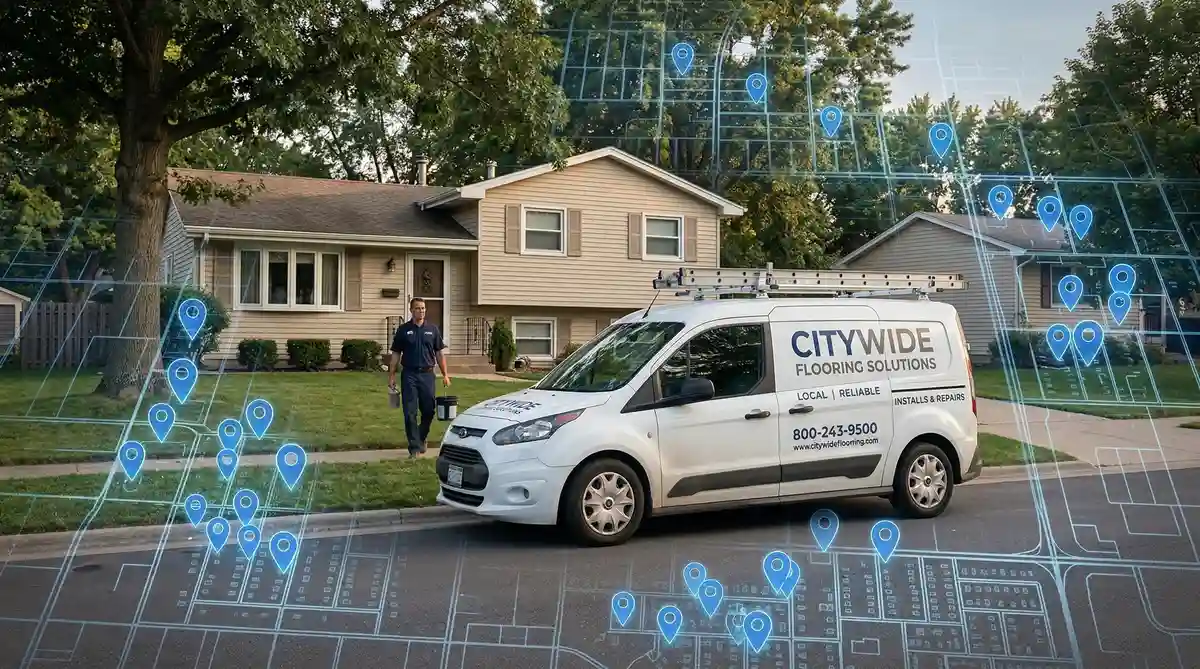
Your transit van is your showroom. It must be perfectly wrapped, heavily branded, and stocked meticulously. Upload high-resolution, wildly bright photos of the interior of your van to your Google Business Profile, showing hundreds of beautiful, organized LVP and hardwood swatches.
Upload photos of your van parked in the driveway of massive, million-dollar homes in your local affluent suburbs. When a high-end customer clicks your mobile map pin, the visuals must instantly communicate: "This is an elite, VIP concierge flooring service that brings the retail experience directly to my kitchen."
5The In-Store 'Check-In' Review Strategy
If you do operate a massive retail showroom, do not wait until the week-long installation is complete to ask for your first review.
The initial showroom consultation is a massive, high-dopamine experience. The customer just looked at 400 different variations of white oak, your design consultant helped them match the exact undertones of their kitchen cabinets, and they are thrilled with their selection.
Strike while the iron is hot. Before they walk out the glass doors of the showroom, the design consultant should ask:
"I had so much fun helping you design this kitchen today! You picked an incredible stain. While we wait for the installation crew to get scheduled, it would mean the world to me personally if you left a quick review about your experience in the showroom today and how we helped you find the perfect match."
This strategy doubles your review velocity, pleasing Google's Local algorithm.